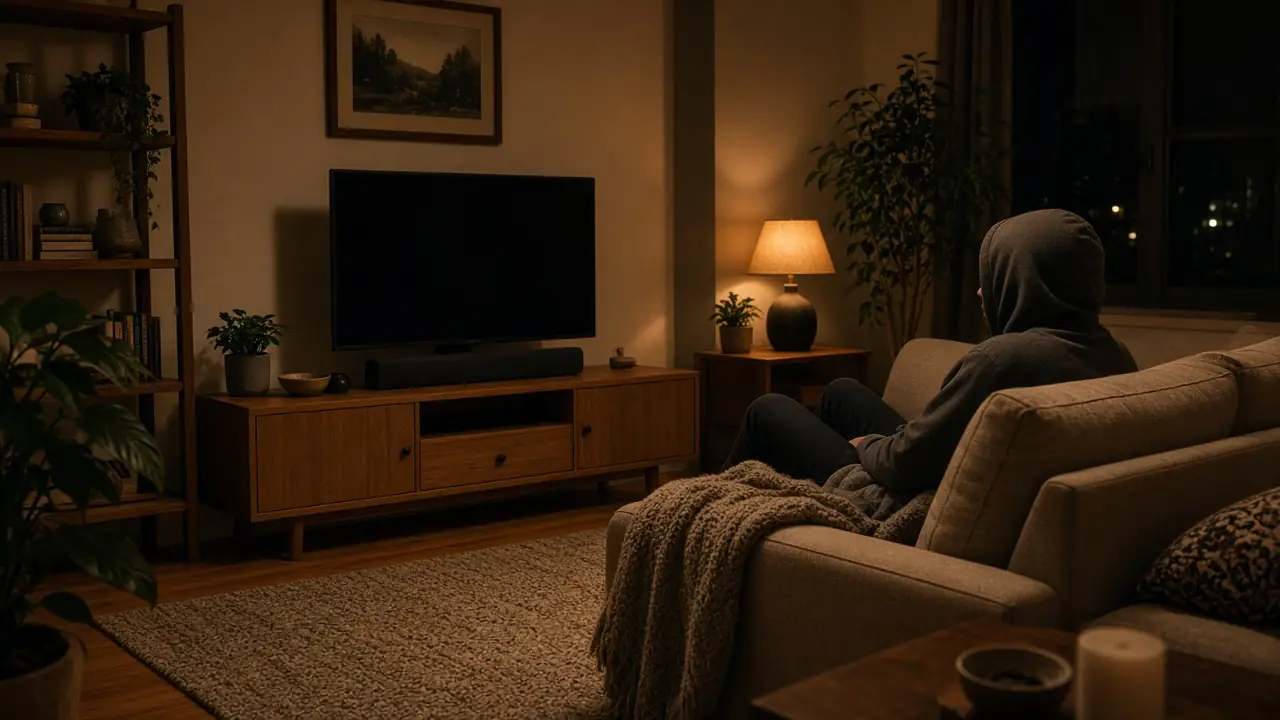
Soundbars That Keep Dialogue Clear Without Shaking the Apartment Below
Paid links: as an Amazon Associate we earn from qualifying purchases, at no extra cost to you. How we make money.
Solved: Get the Sonos Beam (Gen 2). It's a single bar with no separate subwoofer, and its Night Sound and Speech Enhancement keep dialogue clear at low volume. See why ↓
Top 3 picks
Solved it- See it on Amazon Amazon · paid link
The Beam (Gen 2) pairs two separate low-volume tools, Night Sound and Speech Enhancement, with HDMI eARC and a 25.6-inch body that suits most apartment TVs.
- See it on Amazon Amazon · paid link
Best if mumbled dialogue is your main complaint
- See it on Amazon Amazon · paid link
Best budget pick for small TVs and bedrooms
The complaint from downstairs is almost never about voices. It is the low end: explosions, score swells and anything a subwoofer puts into the floor. So the fix for an apartment TV is not a bigger system. It is a bar with no separate sub box, a dialogue mode that lets you keep the volume down, and a night setting that flattens sudden peaks.
Every pick below is a single bar that sits on the console or the wall with its bass drivers built in, so nothing rests directly on the floor. We ranked them on how much control they give you over speech and loudness, then on width, so you can match one to the TV you already own.
The 4 picks
- Sonos Beam (Gen 2) · Best overall for shared floors and late viewing
- Bose Smart Soundbar · Best if mumbled dialogue is your main complaint
- Bose TV Speaker · Best budget pick for small TVs and bedrooms
- Sonos Ray · Best for older TVs with only an optical output
#1: Sonos Beam (Gen 2)
Best overall for shared floors and late viewing
Skip it if you don't want to use an app; setup and the best settings require the Sonos app.
The Beam (Gen 2) earns the top spot because it gives you two independent controls that matter in a building. Night Sound turns down the loudest effects while lifting quiet passages, so you are not riding the remote through every action scene. Speech Enhancement pushes the vocal range forward, which lets you watch at a lower overall level and still follow the plot. Both live in the Sonos app. It connects over HDMI eARC, and Sonos includes an optical adapter for older TVs. At about 25.6 inches wide it fits under 43- to 65-inch sets without looking lost. The tradeoff is that the app is not optional, and adding a Sonos sub later would bring back the exact floor rumble you were trying to avoid.
Why it fits
- Night Sound compresses loud peaks, Speech Enhancement lifts voices
- HDMI eARC, plus optical adapter in the box
Watch out for
- Setup and the best settings require the Sonos app
#2: Bose Smart Soundbar
Best if mumbled dialogue is your main complaint
Skip it if sudden loud peaks are the main complaint; no night mode is listed in Bose's specs.
Bose built this bar around speech. Its A.I. Dialogue Mode listens for voices in real time and rebalances them against effects, which is what you want when a show mixes whispered lines with loud music. You switch it on in the Bose app; Bose notes it turns itself off after standby or an input change, so expect to re-enable it now and then. Inside are five drivers in a 3.0.2 layout: three facing forward and two firing upward for height effects, with no separate subwoofer. It is a little wider than the Beam at 27.3 inches and very slim at 2.2 inches tall. One caution: we did not find a dedicated night mode listed in Bose's specs, so if sudden loud peaks are your neighbors' complaint, the Beam is the safer choice.
Why it fits
- Dialogue processing that adapts scene by scene
- Low-profile body, no subwoofer box
Watch out for
- No night mode listed in Bose's specifications
#3: Bose TV Speaker
Best budget pick for small TVs and bedrooms
Skip it if you need to fill a big open living room, or want a night mode to tame loud peaks.
The TV Speaker is Bose's compact, lower-cost bar, built for bedrooms, small living rooms and narrow media shelves. At 23.38 inches wide and 2.21 inches tall it fits under smaller TVs without blocking the screen, and at about 4.3 pounds it is easy to wall mount with Bose's bracket. Its Dialogue mode separates voices from the rest of the mix and lifts them, and Bose lets you set it to stay on, so you are not re-enabling it every evening. It connects over HDMI ARC, so your TV remote usually controls it, or with the included optical cable, and it streams music over Bluetooth. It has a jack for an optional Bose bass module; for an apartment, skip it. Like the Smart Soundbar, it has no dedicated night mode listed in Bose's specs.
Why it fits
- Dialogue mode can stay on permanently
- Small, light body for shelves and smaller TVs
Watch out for
- No night mode listed; not for big rooms
#4: Sonos Ray
Best for older TVs with only an optical output
Skip it if your TV has no optical audio output; the Ray has no HDMI input.
If your TV is older or has no HDMI ARC port, the Ray is the simplest fix on this list. It connects with a single optical cable, which Sonos includes, and it has no HDMI input at all, so confirm your TV has an optical digital audio output first. It shares the Beam's two apartment-friendly tools: Night Sound to tame loud moments and Speech Enhancement to bring voices forward, both set in the Sonos app. At under 22 inches wide it is the narrowest bar here, which suits dressers, small consoles and bedroom TVs. The catch is that optical audio limits what formats it can receive, and it is a stereo bar rather than a true three-channel design, so voices are clear but less firmly anchored to the screen.
Why it fits
- One optical cable, works with older TVs
- Night Sound and Speech Enhancement, same as the Beam
Watch out for
- No HDMI; optical only
Quick comparison
Get the Sonos Beam (Gen 2) if your TV has HDMI eARC and you want the most control over loudness at night. Choose the Bose Smart Soundbar if unclear dialogue bothers you more than loud peaks. The Bose TV Speaker is the budget pick for smaller TVs, and the Sonos Ray is the one to buy when your TV only has an optical output.
| # | Product | Best for | Key spec | Link |
|---|---|---|---|---|
| 1 | Sonos Beam (Gen 2) | Best overall for shared floors and late viewing | 25.63 in wide, HDMI eARC, Night Sound + Speech Enhancement | See it on Amazon |
| 2 | Bose Smart Soundbar | Best if mumbled dialogue is your main complaint | 27.34 in wide, 3.0.2 channels, A.I. Dialogue Mode | See it on Amazon |
| 3 | Bose TV Speaker | Best budget pick for small TVs and bedrooms | 23.38 in wide, 2.21 in tall, persistent Dialogue mode | See it on Amazon |
| 4 | Sonos Ray | Best for older TVs with only an optical output | 21.93 in wide, optical input only, Night Sound | See it on Amazon |
Before you buy: check your TV’s ports
Look on the back of your TV for an HDMI port labeled ARC or eARC. If you have one, any bar here will work and the TV remote will usually control its volume. If you only see an optical (Toslink) output, the Sonos Ray is the straightforward match, and the Beam also works using its included optical adapter.
Where the sound actually goes
Bass is what carries into the unit below, and it gets worse when a speaker sits directly on the floor or on hollow furniture against a shared wall. Keep the bar on a solid console or mount it, keep it away from party walls if you can, and use night or dialogue modes instead of turning the master volume up.
Frequently asked questions
Will a soundbar bother my downstairs neighbors?
Usually far less than a separate subwoofer. Low frequencies travel through floors and walls much more easily than speech, so a bar with its bass drivers built in, used with a night or dialogue mode at moderate volume, is the lowest-risk way to upgrade TV sound in an apartment.
Should I add a wireless subwoofer later?
Not if neighbors below are the concern. A sub sitting on the floor couples bass straight into the structure. If you add one anyway, keep it off shared walls, set its level low in the app and put it on an isolation pad.
What is the difference between night mode and dialogue mode?
Night modes compress the range between quiet and loud parts so explosions do not jump out. Dialogue modes boost the vocal frequencies so speech stays clear at a lower overall volume. In an apartment, you usually want both.
Is wall mounting better than putting the bar on a TV stand?
Either works. Wall mounting keeps the bar off furniture that can buzz along with it. Just check your lease before drilling, and avoid mounting on a wall you share with another unit.